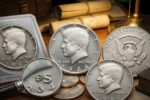
Rare Bicentennial Quarter: In 2026, the legend of the $3.2 million Bicentennial Quarter has reached a fever pitch. While the vast majority of the 1.6 billion quarters minted for the 1776–1976 celebration are worth exactly 25 cents, a select few specimens particularly those struck in 40% silver or possessing catastrophic mint errors have entered the elite realm of million-dollar numismatics.
Rare Bicentennial Quarter Value Chart (2026)
| Variety / Error Type | Composition | Key Rarity Feature | 2026 Estimated Value |
| Bicentennial “Mule” Error | Silver/Clad | Struck with incorrect metal or dies | $500,000 – $3,200,000+ |
| 1976-S Silver Proof (MS69) | 40% Silver | Flawless strike; mirror finish | $5,000 – $15,000+ |
| Double Die Obverse (DDO) | Clad | Distinct doubling on “LIBERTY” | $200 – $3,500+ |
| Off-Center Strike (50%+) | Clad | Design significantly misaligned | $1,000 – $10,000+ |
| Standard Circulation | Clad | No errors; typical wear | $0.25 (Face Value) |
The Secret of the $3.2 Million Specimen
A valuation of $3.2 million is not for a standard coin found in a vending machine. This price point is reserved for a theoretical or unique “Mule” error a coin struck on a planchet (metal blank) intended for a different coin or a different year. For example, a Bicentennial Quarter struck on a 90% silver planchet from 1964 or an experimental alloy that escaped the mint would create the kind of “one-of-a-kind” rarity that drives multi-million dollar bidding wars at auction houses like Heritage or Sotheby’s.
How to Identify a High-Value Find
If you are searching your change in 2026, keep an eye out for these three specific markers that differentiate a common quarter from a potential treasure:
- The Silver Edge: Check the side of the coin. If you see a solid silver-colored edge with no brown copper stripe, you may have a 40% silver version. While common in sets, finding one in circulation is rare.
- The “S” Mint Mark: Look just to the right of Washington’s ponytail. An “S” indicates the coin was minted in San Francisco. These were typically reserved for collector sets and are far more likely to hold high value than “P” (Philadelphia) or “D” (Denver) marks.
- Visual Doubling: Use a magnifying glass to inspect the words “LIBERTY” and the dual date “1776–1976.” If the letters appear “thick” or have a clear second set of lines, you may have found a Doubled Die error.
The 2026 Market for Commemorative Coins
With the United States celebrating its 250th anniversary (Semiquincentennial) in 2026, interest in the original 1976 Bicentennial coinage has hit an all-time high. New collectors are entering the market, driving up the price of high-grade, professionally certified coins. In 2026, a coin’s value is solidified by its “slab” or certification from services like PCGS or NGC. Without this, even a genuine error may struggle to reach its full price potential.
H2 Final Verdict
The $3.2 million Bicentennial Quarter remains the “Holy Grail” of modern American coinage. While finding a multi-million dollar specimen is nearly impossible, the search itself is rewarding. Genuine 40% silver proofs and striking mint errors are still being discovered in old collections and jars. Always check the weight and the mint mark; even if it isn’t worth millions, a silver Bicentennial Quarter is a beautiful piece of history that is consistently worth more than its face value.
H2 Disclaimer
This guide is based on 2026 market trends and theoretical auction data. Most Bicentennial Quarters remain common. No $3.2 million sale has been publicly verified for a standard circulation quarter. Always consult a professional appraiser before buying or selling high-value coins.